A two-story red brick house with black shutters and a gray roof sits behind a mowed lawn, framed by large deciduous trees, with a dry-stacked stone wall in the foreground.

Heat Pump Repair in Middletown, CT

Tell us about the job

Takes about a minute. No obligation.

RepairHeat PumpLower Connecticut River Valley Planning Region, CT
Step 1 of 2

What ZIP code is the job in?

September is when a weak heat pump shows itself

Heat here runs October through May, and before that the system has sat idle since the cooling months ended in August. The first real cold snap in October puts a full load on parts that were already marginal, and that's when they fail.

Get it looked at in September, not October

A heat pump acting up in September is easier to diagnose than the same unit called in once it's working hard every day. Waiting just means doing the same job with less room to spare.

8 months
October through May, your system heats
3 months
June through August, it cools
23°F
the average winter night it heats against
82°F
the average summer afternoon it cools against
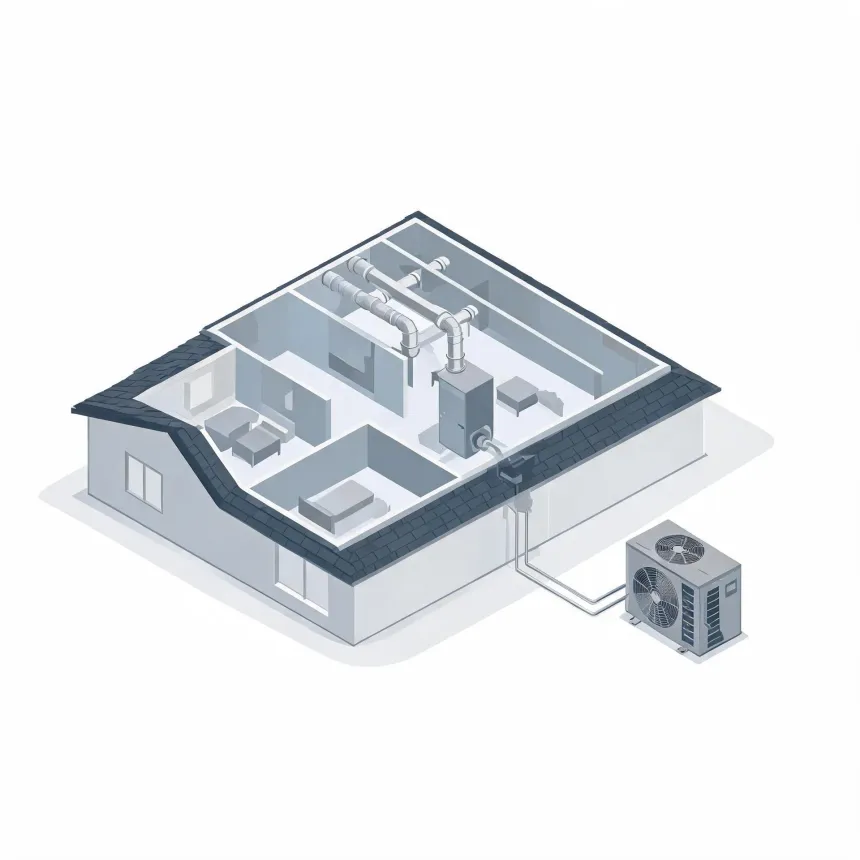
Isometric cutaway illustration of a single-story house showing interior rooms with ductwork, a furnace or air handler, and refrigerant lines running outside to a condenser unit on a pad.
Your system heats October through May and cools June through August.

NOAA 1991–2020 monthly normals

Winter nights in this part of Connecticut average 23°F, not far below what a heat pump is built to handle.

A unit that hasn't been pushed hard usually fails from something specific, like a bad capacitor or low refrigerant, so repair is usually the right call.

At 28.75 cents a kilowatt-hour, a struggling heat pump runs up your bill every day it's not fixed

Power costs 28.75 cents a kWh statewide
Winter nights average 23°F
Cooling runs June through August
Nothing unusual here, just the usual failure20% of Connecticut households lost power for a day or more in 2024

Half the homes in this part of Connecticut were built in 1972 or earlier. If your heat pump came with a house that old, it's worth finding out how old the unit itself is, since a system can be replaced more than once over a house's life. An older unit works the same as a new one when it's running right, but it has less life left to run a repair against. A compressor on its last year isn't worth much chasing a leak. One with five years left usually is.

A heat pump in decent shape is worth fixing

This unit was never pushed hard. Nights here average 23°F, well within what it was built to handle, so a breakdown is more likely a bad capacitor or a low charge than real wear. That kind of problem gets fixed, not replaced.

Find a contractor
A gray air-source heat pump mounted on a concrete pad next to a house with gray vinyl siding, surrounded by gravel and flanked by green shrubs and white hydrangea flowers.

Check the unit's age, not just the house's

A tech can check the age on the unit itself in a few minutes, usually off a sticker inside the cabinet. That number matters more than the house's age does. If the unit is getting old, ask what a repair buys before paying for one. If it was put in recently, the age of the house around it doesn't count for much.

A capacitor failure looks electrical, and it is

The capacitor gives the compressor and fan motor the jolt they need to start. It weakens slowly, then one day the fan hums but won't spin, or the compressor won't start at all. It's one of the most common reasons for a no-start call, and one of the quicker ones to confirm.

Refrigerant doesn't run out, it leaks out

A heat pump is a sealed system. If the charge is low, something let it escape, usually a fitting, a coil, or a line that's rubbed through. Adding refrigerant without finding where it left just means the level drops again later. A tech who tops off the charge should be able to say where it was leaving from.

Before you call anyone, there are a few things worth a look. Check the thermostat is set to heat and the set point is actually above room temperature, since a setting bumped by accident gets mistaken for a real failure often enough. Go outside and look at the outdoor unit. If the coil is caked in ice or buried under leaves and debris, airflow is blocked and the system can't do its job. Check the breaker it's on, since a tripped breaker will shut the whole unit down with no other symptom. Inside, pull the filter and hold it up to a light. If you can't see through it, that's restricting airflow to the point where the system struggles, and it's a quick fix. None of this fixes a bad capacitor or a refrigerant leak, but it rules out the simple stuff first.

A compressor doesn't usually fail out of nowhere. It gives some warning first, like the unit short cycling, a breaker that trips more than once, or a fan that spins slower than it should. Those signs point to a specific part acting up, not the system wearing out from end to end. A repair makes sense when it's one part causing the trouble inside a system that otherwise still runs right. Replacement starts to make more sense when a tech fixes one thing and keeps finding the next thing wrong after it, since that pattern says more than any single failure does. The coil and the fan motor can usually be swapped on their own without much argument. The compressor is the one part worth pausing on, since it's expensive enough and central enough to change the math on whether a repair is worth doing at all.