






Overhead view of a gray residential air conditioning condenser unit mounted on a concrete pad beside a house with asphalt shingle roofing.

AC Repair in New Haven, CT

Tell us about the job

Takes about a minute. No obligation.

RepairCentral ACSouth Central Connecticut Planning Region, CT
Step 1 of 2

What ZIP code is the job in?

Your AC only has to work hard three months a year here, June through August. Afternoon highs in those months average 81, which is not extreme heat. The rest of the year it mostly sits idle. That kind of schedule is easy on a compressor and condenser coil compared to places where cooling runs most of the year against much higher highs. So when a system here breaks down, it is usually not because the unit got run into the ground. More often it is age, a part that failed on its own, or something that got skipped at a tune-up. That is worth knowing before you decide whether to fix it or replace it.

3 months
June through August, your air conditioner is on duty
81°F
the average summer afternoon it cools against
Isometric line illustration of a cutaway single-story house showing interior rooms with furniture, ceiling ductwork, an indoor air handler, and an outdoor condenser unit connected by lines along the exterior wall.
Your air conditioner works hardest from July through August.

NOAA 1991–2020 monthly normals

New Haven starts running AC in June.

May is when a weak capacitor or low charge shows itself, right before the system has to work.

Half the homes here were built by 1964, old enough that the AC itself, not the house, is probably due for a look

Half the homes here were built by 1964
Cooling runs June through August
Summer afternoons average 81°F

A power outage can knock a system offline without damaging it. About 20% of Connecticut households went at least 24 hours without power in 2024. If your AC stopped working after a storm, check the breaker before you assume the worst. Most outdoor units need a manual reset at the disconnect box, or the breaker just needs to be flipped back. If it still will not start after that, something else is going on and it is worth getting a contractor to look at it.

A struggling AC costs more to run here than in most places

Electricity in Connecticut ran 28.75 cents per kilowatthour in 2024, among the highest rates around. A failing capacitor or a low charge makes the compressor work harder to do the same job, and you pay for that extra draw every time the system cycles on. Fixing it now stops the waste instead of paying it all summer.

Find a contractor
A man in a cap, gray shirt and brown work pants walks up steps toward a dark green front door, carrying a canvas tool bag beside a potted shrub.
An outdoor air conditioning condenser unit mounted on a concrete pad surrounded by gravel, photographed against a partly cloudy blue sky.

Three months of work a year, that's it

Three months of real work a year does not wear out a compressor fast. If your system is十 years old or more and still running fine, that track record counts for something. A repair now is likely to hold.

What you'll notice first

Warm air coming out of the vents, or air moving but not cooling, usually means the compressor isn't doing its job or the charge is low. Short cycling, where the system shuts off a few minutes after it starts, often points to a dirty coil or a sensor reading wrong. A system that runs constantly without hitting the temperature you set has lost either capacity or airflow somewhere.

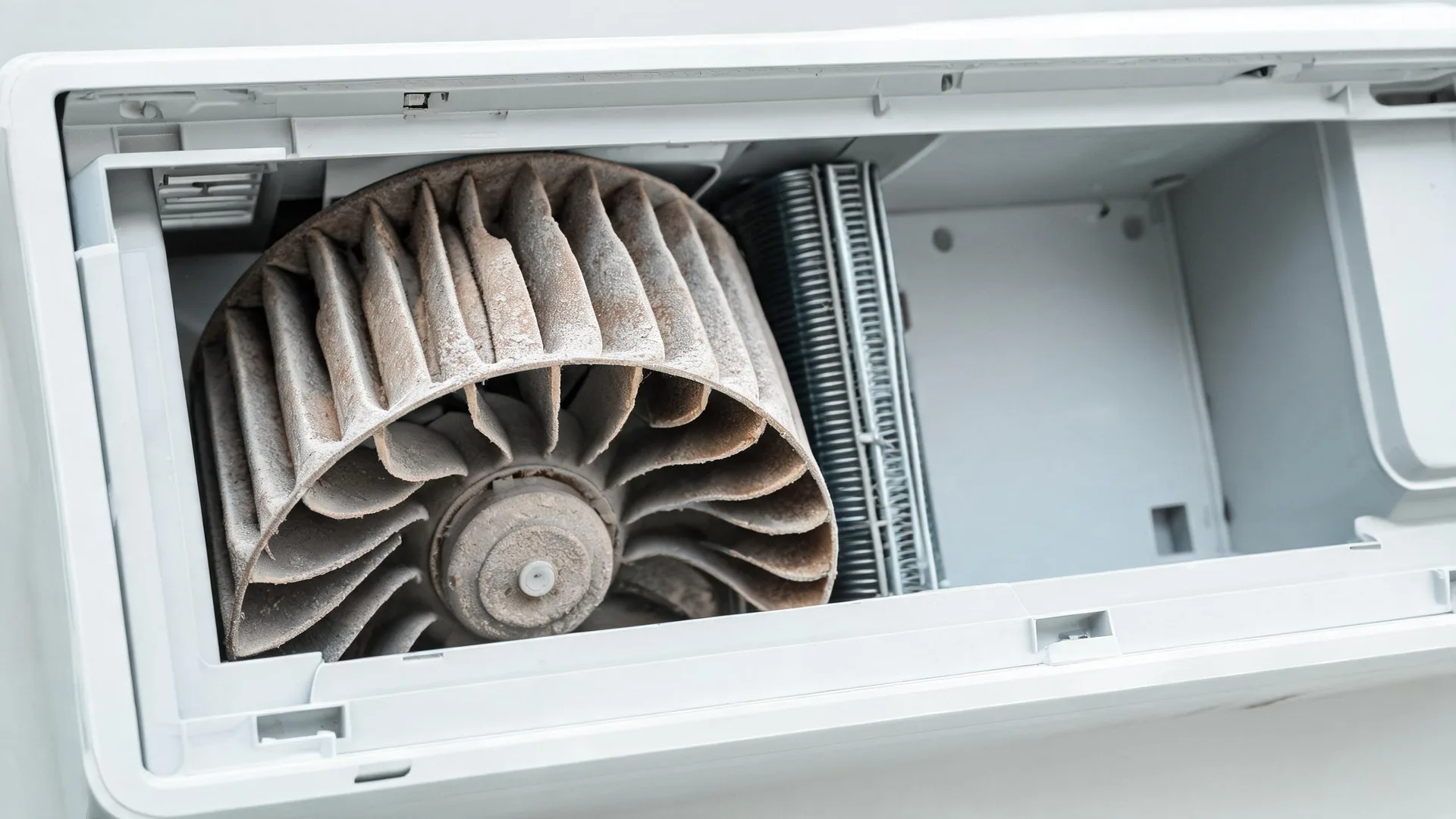
What the sound and the smell tell you

A hard clunk or bang at startup is often a bad capacitor or a motor mount worn loose. A hissing sound can mean refrigerant escaping from a line. Musty air points to moisture sitting in the ductwork or on the coil, and a burning smell means stop running the system and get it looked at before anything else.

Overhead view of an outdoor AC condenser unit on a concrete pad next to a house with a dark shingle roof.

A new air conditioner would cut about $30 a year off cooling for a typical New Haven home.

  • A new one at the federal minimum, 13.4 SEER2$340 a year
  • An older air conditioner$370 a year

Estimates for a typical New Haven home, compared with an older unit built to the previous federal minimum, from EIA household energy data, Connecticut fuel prices and NOAA climate normals. Your home will differ.

Repair makes sense when a part like a capacitor or contactor has failed.

Replacement makes sense when the compressor has failed or the system uses R-22 refrigerant, which is no longer made.

A diagnostic visit starts outside, at the condenser. A tech checks the capacitor, the contactor, and the refrigerant charge, since those cause most no-cool calls. Inside, they check the evaporator coil for ice or dirt, and pull the filter to see if air is actually getting through it. They run the system through a full cycle instead of just glancing at it, because some faults only show up once the compressor has been working for a while. A set of gauges tells them whether the charge is low, which points to a leak in the lines rather than just needing a top-off. By the end they can usually tell you which part failed, whether it is worth repairing, and what let it happen in the first place.