A row of white Colonial-style houses with glowing windows photographed at dusk along a road bordered by a stone wall.

Mini Split Installation in New Haven, CT

Tell us about the job

Takes about a minute. No obligation.

New system or replacementMini-splitSouth Central Connecticut Planning Region, CT
Step 1 of 2

What ZIP code is the job in?

Electricity here runs 28.75 cents per kilowatthour

Connecticut households paid that rate in 2024, well above the national average. A mini split that runs on electricity all summer and, if you use it for heat, through the cold months too will show that rate on every bill.

The efficiency rating is what you're paying for

Two mini splits can cost the same to install and run very differently. At this electric rate, the difference between a unit that sips power and one that doesn't shows up fast, so the SEER2 and HSPF2 numbers on the spec sheet matter more here than in a state with cheaper power.

8 months
October through May, your system heats
3 months
June through August, it cools
25°F
the average winter night it heats against
81°F
the average summer afternoon it cools against
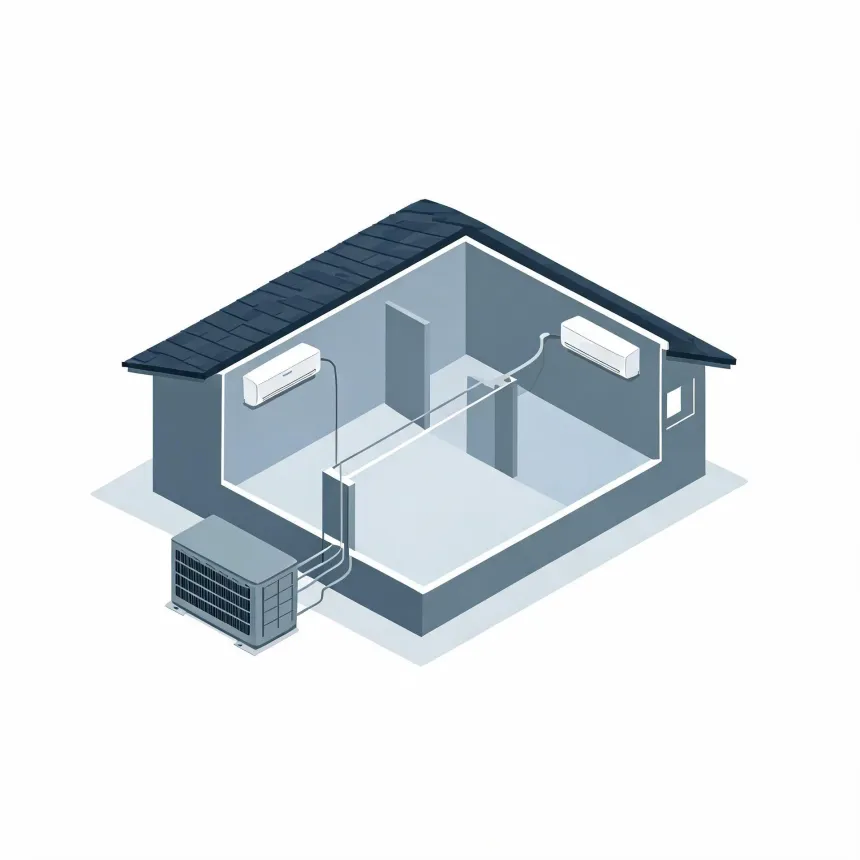
Isometric illustration of a cutaway house showing two wall-mounted mini-split indoor units connected by line sets to a single outdoor condenser beside the exterior wall.
Your system heats October through May and cools June through August.

NOAA 1991–2020 monthly normals

Cooling here runs June through August.

Get a mini split installed before May and it's ready on day one of summer, not day three of a heat wave.

Half the homes here were built by 1964. An older house built before ductwork was standard is exactly where a mini split fits best.

Half the homes here were built by 1964
Cooling runs June through August
Summer afternoons average 81°F
Three months of work a yearSummers here average 81°F, June through August. This isn't a system working against extreme heat all season.

Fuel oil heats close to 3 in 10 homes in this region, and gas heats almost half. A mini split doesn't compete with either one. It runs on electricity, so it's usually going in alongside the furnace or boiler already there, not replacing it outright. In a house that heats with oil, that split handles cooling all summer and can take over heating duty on the mild days in spring and fall, leaving the furnace for the cold stretch. That's a different job than installing one in a home that already runs on electric heat, where it might carry more of the load year round.

Efficiency pays here

Power costs more here, so an efficient system pays you back on every bill.

Find a contractor
A beige split-system air conditioner outdoor condenser unit mounted on metal wall brackets atop a stucco wall.

It won't work hard, so it doesn't need to be the top of the line

At 81°F, a mini split here isn't straining to catch up on the hottest stretch of the year. Three months of moderate load is a light job for a condenser. You don't need the highest SEER2 number on the lot to get a unit that keeps up. A mid-range model sized right for the room will hold its own in August without running flat out, and it's one less thing to compare while you're already weighing brands and installers.

The number of heads drives the cost

Every indoor head needs its own line set run from the outdoor unit, its own mounting spot, and its own place in the system the outdoor condenser has to be sized to handle. A single room with one head is a straightforward job. Add a second or third head for other rooms and the labor multiplies along with it, not just the equipment.

What's already there changes the work

Running a line set through a finished wall takes more time than running it through an open stud bay or a basement ceiling. A condenser pad on level ground near the house goes in faster than one that needs a bracket mounted up a wall or a longer line run to reach a spot with clearance. None of that shows up on the spec sheet, but it shows up in the labor.

Sizing a mini split comes down to how much heat the room gains and loses, not how big the room looks. A contractor works this out room by room, checking window area, insulation, ceiling height and what's on the other side of each wall. Skip that step and guess from square footage alone, and the unit ends up wrong in one direction or the other. Too big, and it cools the air fast then shuts off before it pulls the moisture out, so the room feels cold and damp at once. Too small, and it runs flat out all afternoon trying to catch up, and never quite does. Either way the fix isn't a better thermostat or a different setting. It's a different size unit.

Installation starts outside, with the outdoor condenser. It needs clearance on all sides to pull air through the coil and a mounting pad or bracket that holds it level and off the ground. Inside, each indoor head gets mounted high on a wall or in the ceiling, over the spot where the line set can reach the outside unit through a small hole drilled in the wall. That line set carries refrigerant lines, a condensate drain and electrical wiring together in one bundle, wrapped and run neatly rather than left loose. Once everything's connected, the system gets evacuated with a vacuum pump to pull out air and moisture before refrigerant goes in, then charged to the weight the manufacturer specifies for that line length. The last step is running it through both modes, checking the temperature split at each head and listening for anything that doesn't sound right before calling it done.